Free Excel Template
Summit On-demand: Project Accounting, Job Costing & Grant Management
Learn how to streamline job costing, track grants with confidence, and maintain compliance with ASC 606—without sacrificing productivity
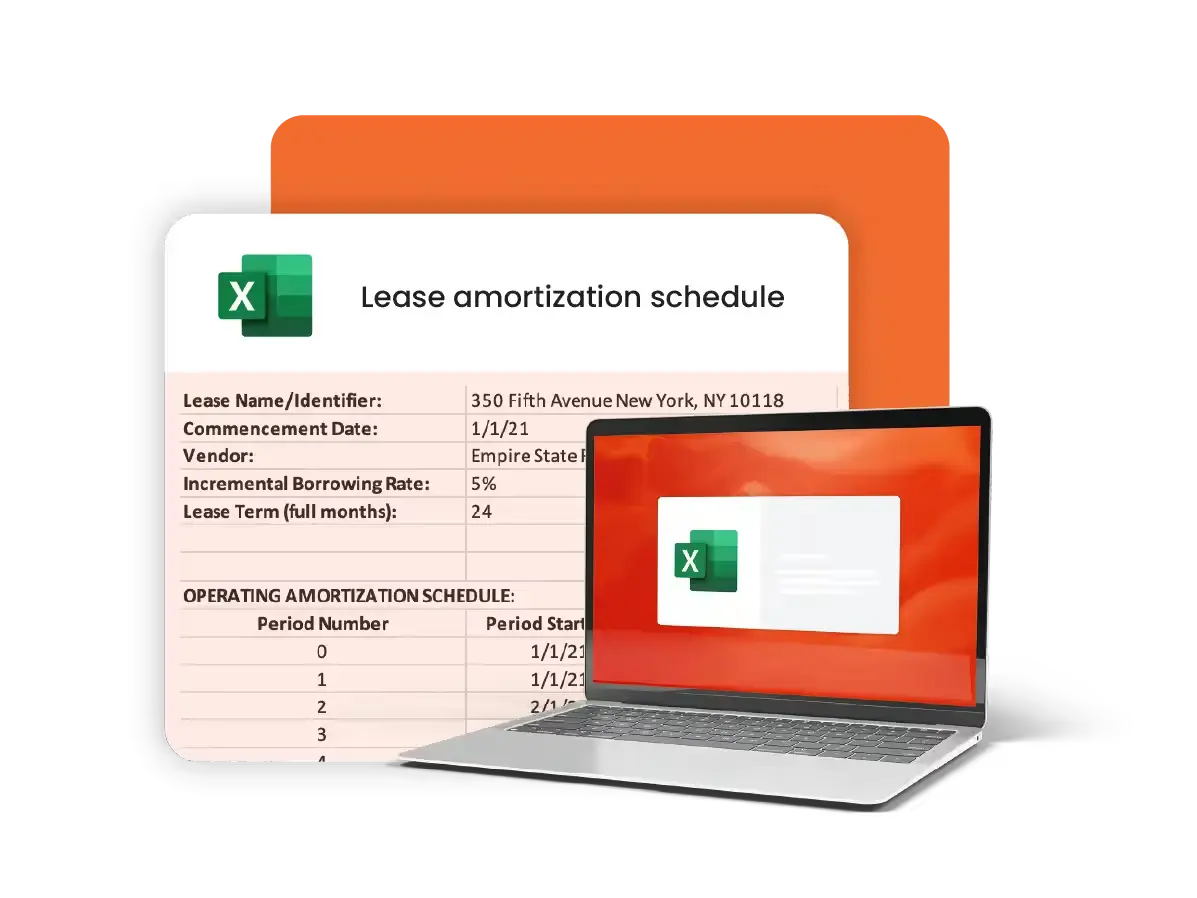
Get your free template
Complete the form and you'll be redirected to the resource











What's inside the template
Netgain was founded by accountants who know exactly what your day to day looks like. Our mission is to design tools and software that help you work better, faster, and more accurately.

Accuracy from the start
A ready-to-use amortization table in Excel, no formulas to build from scratch

Interest expense
The portion of each payment applied to interest on the lease liability under the effective interest method.

Principal reduction
The portion of each payment that reduces the lease liability and repays the obligation over time.

Remaining liability
The outstanding balance yet to be repaid, decreasing with each payment until the term ends.
What is a lease amortization schedule?
A lease amortization schedule, sometimes called a lease payment schedule, is a financial tool used to outline the repayment plan of a lease agreement over its duration. It provides a detailed breakdown of lease payments, interest expenses, and principal reductions, so you can assess the impact of leases on the balance sheet and income statement.
1
Lease payment
The contractual payment from lessee to lessor over the term, comprising principal and interest.
2
Interest expense
The portion of each payment applied to interest on the lease liability under the effective interest method.
3
Principal reduction
The portion of each payment that reduces the lease liability and repays the obligation over time.
4
Remaining liability
The outstanding balance yet to be repaid, decreasing with each payment until the term ends.
Creating an ASC 842 compliant amortization schedule: step-by-step guide
To meet ASC 842 requirements, you need a detailed approach to lease accounting, particularly with the amortization of lease liabilities. Here is a guide for creating an ASC 842 compliant schedule.

1. Identify and classify your leases
Begin by inventorying all lease agreements to determine which contracts qualify under ASC 842. Classify each lease as either a finance lease or an operating lease based on criteria such as transfer of ownership, purchase options, lease term, and the present value of lease payments.

2. Determine the lease term
Include the non-cancellable period of the lease in your calculations. Consider any options to extend or terminate the lease and include them if it is reasonably certain they will be exercised.

3. Calculate the lease liability
Calculate the present value of future lease payments using the appropriate discount rate, which is either the rate implicit in the lease or the lessee's incremental borrowing rate. Ensure that variable lease payments that depend on an index or a rate are initially measured using the index or rate as of the commencement date.

4. Establish the right-of-use asset
Start with the initial measurement of the lease liability, then add any lease prepayments and initial direct costs incurred. Subtract any lease incentives received from the lessor to arrive at the initial value of the right-of-use (ROU) asset.

5. Prepare the amortization schedule
For finance leases, separate the interest and amortization of the ROU asset in the schedule, reflecting a front-loaded expense pattern. For operating leases, combine these amounts to reflect a straight-line expense pattern over the lease term.

6. Record journal entries
Record the diminishing balance of the lease liability and the corresponding interest expense for finance leases. Adjust the ROU asset for amortization and present the single lease cost for operating leases, reflecting the straight-line expense pattern.

7. Reassess and update the schedule as neccessary
Regularly review the lease terms for modifications that may affect the lease classification, lease term, or the discount rate. Adjust the amortization schedule to reflect any remeasurements or modifications to the lease agreement.

8. Disclosures
Provide a clear and comprehensive disclosure of your lease obligations, including the nature of the leases, significant terms and conditions, and information about lease liabilities and ROU assets. Include information about the timing and amount of lease payments, along with the specific line items in the financial statements affected by lease accounting.
Best practices for maintaining an ASC 842 amortization schedule
A few habits keep your schedules accurate, auditable, and ready for whatever the standard, or your auditor, asks for next.

Review and update lease terms
Monitor extensions, terminations, and modifications, and reassess renewal or purchase options that move the liability and ROU asset.
Keep data entry accurate
Use a double-entry check to minimize errors, and update the schedule promptly so the figures stay accurate and relevant.

Stay audit-ready
Maintain a clear audit trail and keep schedules in an audit-ready state that supports the disclosures ASC 842 requires.
Final thoughts on lease amortization schedules
A lease amortization schedule within Excel gives you a clean breakdown of payments, interest, and principal while keeping you aligned with ASC 842 requirments. The catch is, a spreadsheet only stays accurate until the next modification, renewal, or new lease lands on your desk. That is the point where most teams move on to a more flexible solution.
Accounting teams on NetSuite
NetLease
NetLease for NetSuite is native lease accounting software that automates ASC 842, IFRS 16, and GASB 87 right inside the NetSuite ERP. Ditch the spreadsheet gymnastics, book ROU assets and journal entries, then walk into the audit calm and ready.
NetAsset
NetAsset for NetSuite is native fixed asset management software that automates depreciation across your full asset lifecycle in NetSuite. From acquisition to disposal, every asset stays reconciled and report-ready, so month-end stays drama-free.
Accounting teams not on NetSuite
NetLease
NetLease lease accounting software automates ASC 842, IFRS 16, and GASB 87 alongside any ERP or accounting system. Pull every lease, ROU asset, and journal entry into one place, so the standards stop running your busy quarter.
NetAsset
NetAsset fixed asset management software automates depreciation across the full asset lifecycle alongside any ERP. Handle acquisitions, depreciation, and disposals in one place, so depreciation runs take minutes, not weekends.