What is a depreciation schedule?
What is a depreciation schedule? It's a table tracking how an asset's cost is expensed over its useful life. See methods, a worked example, and FAQs.
What is a depreciation schedule?
A guide for accounting and finance teams
Depreciation is another word for expense, specific to assets. “Assets” is a word used for something purchased at a company that holds long-term value. So when you purchase, for example, a desk, the desk brings value to your company for longer than a year. The desk is an asset. Tax rules limit how much of a long-lived asset's cost you can deduct up front. Because the desk will keep delivering value for years, its cost gets spread across those years too. The expense spread over a period of time is called a depreciation schedule.
Put simply, a depreciation schedule is a table that shows how much of an asset you get to write off as an expense each year. It lists the asset, how much it cost, how many years you will spread the cost over, and how much value is left at any point in time. If you can read a simple table, you can read a depreciation schedule.
Why can't you just expense the whole thing at once?
It comes down to matching the expense to the years you actually use the asset. Think back to the desk. If you paid $1,000 for it and used up that entire $1,000 as an expense in the month you bought it, your books would look like you had a terrible month, even though the desk will keep helping your business for years.
Depreciation fixes that. Instead of one big expense on day one, you record a small piece of the cost each month for as long as you expect to use the desk. That way your financial reports show a steadier, more honest picture of how the business is doing. The depreciation schedule is simply the running record that keeps track of those pieces.
Tax rules require the same treatment, on their own schedule. Most tax authorities will not let you deduct the full cost of a long-lived asset in the year you buy it. They require you to spread the deduction across the years you use the asset, and the tax depreciation schedule documents exactly how you did that.
A few words you'll see
Accounting has its own vocabulary. Here are the terms that show up on almost every depreciation schedule:
- Asset. Something the company buys that will be useful for more than a year, like a desk, a laptop, a van, or a building.
- Cost. What you paid to buy the asset and get it ready to use.
- Useful life. Your best estimate of how many years the asset will be useful. A laptop might be 3 years; a building might be 30.
- Salvage value. What you think the asset will be worth at the very end, when you are done with it. Also called residual value. Most people assume this is zero.
- Depreciation expense. The chunk of cost you record as an expense every month.
- Accumulated depreciation. A running total of all the expense you have recorded so far. It only grows over time.
- Book value. What the asset is still worth on paper: the original cost minus the accumulated depreciation.
What goes on a depreciation schedule
A depreciation schedule can be a single row in a spreadsheet or a giant list with thousands of assets. Either way, for each asset it usually shows:
- The name of the asset and the date you started using it.
- How much it cost.
- How many years you will spread the cost over (its useful life).
- What you expect it to be worth at the end (salvage value).
- The method you are using to spread the cost (more on that next).
- The expense for each year, the total expensed so far, and the value that is left.
The most common ways to calculate depreciation
There is more than one way to slice up the cost. The method you pick just decides how fast the expense gets recorded. Here are the four you will hear about most, with no math degree required:
Source: Corporate Finance Institute; Deskera.
If you are just starting out, straight-line is the one to learn first. It is the simplest and by far the most common.
A simple example you can follow
Say your company buys a delivery van for $50,000. You expect to use it for 5 years, and you think you can sell it for about $5,000 when you are done. That $5,000 is the salvage value.
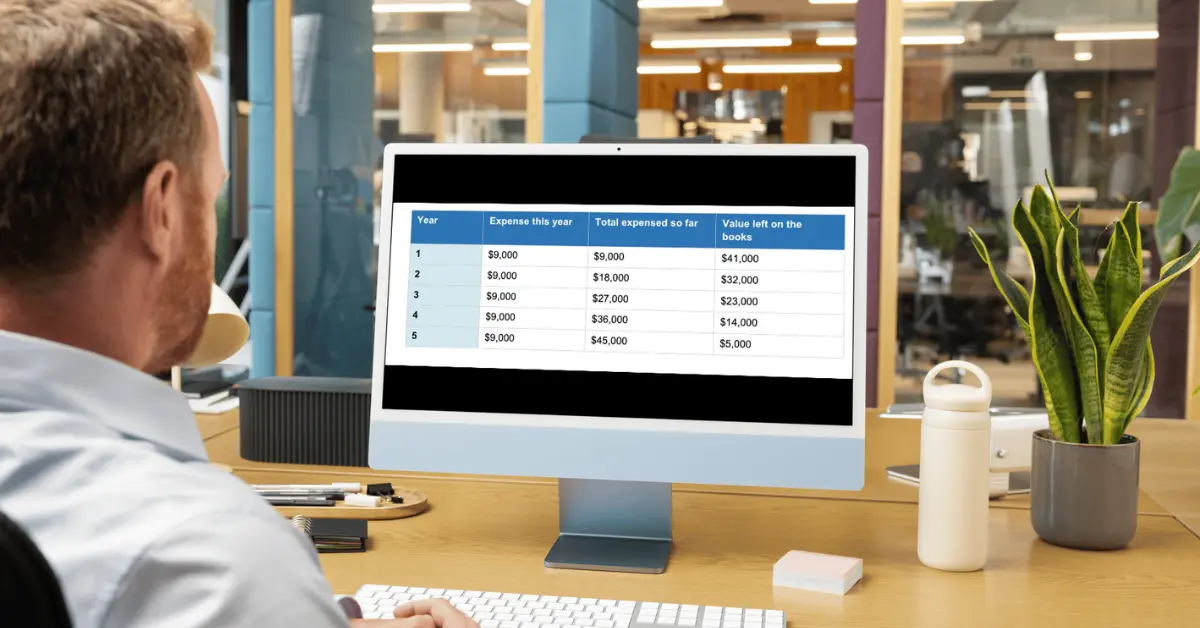
Using the straight-line method, you take the cost, subtract the salvage value, and divide by the years: ($50,000 − $5,000) ÷ 5 = $9,000 per year. So you record $9,000 of expense each year for five years. Here is what that looks like on a depreciation schedule:
Read across any row and you can see the whole story: how much expense you took that year, how much you have expensed in total, and how much value is still sitting on the books. By the end of year 5, you have expensed $45,000 and the van is worth its $5,000 salvage value, exactly as planned.
That is the entire idea. A depreciation schedule just does this for every asset a company owns and keeps the running totals straight.
Why some companies keep two schedules
Here is a wrinkle that trips up a lot of newcomers. A company often keeps two depreciation schedules for the same assets: one for its own financial reports and one for taxes.
The reports version follows standard accounting rules and usually uses the straightforward straight-line method. The tax version follows IRS rules, which in the United States use a system called the Modified Accelerated Cost Recovery System (MACRS). The tax rules also offer perks that let businesses deduct more, faster. For example, current federal rules allow 100% bonus depreciation on many assets placed in service after January 19, 2025, and a Section 179 rule that lets smaller businesses expense up to $2,560,000 of qualifying purchases in tax years beginning in 2026.
The takeaway for a beginner: do not panic if the two schedules do not match. They are supposed to be different, and accountants reconcile the gap. You do not need to memorize the tax rules to understand what a depreciation schedule is.
Tax figures are general and change over time. Always confirm current rules with a tax professional or IRS Publication 946. Source: IRS; Section179.org; Forbes.
How to make a depreciation schedule, step by step
- List each asset. Write down what you bought, when you started using it, how much it cost, how long it will last, and its salvage value.
- Pick a method. For most beginners, straight-line is the safe, standard choice.
- Do the yearly math. Figure out the expense for each year and update the total expensed and the value that is left.
- Keep it in step with your books. Make sure the schedule matches the numbers in your accounting records.
- Update it when things change. Add new purchases, remove things you sell or throw away, and adjust if your estimates change.
A spreadsheet is fine when you have a few assets. But as a business grows to dozens or hundreds of items, doing this by hand gets slow and easy to get wrong. Formulas break, sold items get forgotten, and keeping the reports and tax versions in sync becomes a monthly headache. That is why most growing companies eventually switch to software that does the calculations and updates automatically.
If a company runs its accounting in NetSuite, Netgain's NetAsset handles depreciation for you right inside the system, so the schedule stays accurate and the monthly close goes faster.
Frequently asked questions
Is a depreciation schedule the same as a depreciation method?
No, but they work together. A method is the way you calculate the expense, like straight-line. A depreciation schedule is the table that takes a method and shows the results, year by year, for a specific asset.
Which method should I use for my assets?
Straight-line is what 99% of people use for all their assets. It is the most widely used option for financial reports. Usage is actually the next most common that we see.
Can I choose the length of time to depreciate over?
Short answer is yes with caveats. There are generally accepted useful lifes for assets and anything different from that typically needs to be approved by an auditor.
What is accumulated depreciation, in one sentence?
It is the sum total of all the depreciation expense you have recorded for an asset since you started using it.
Do you depreciate land?
No. Land does not wear out or get used up, so it is not depreciated. A building sitting on the land does get depreciated, but the land itself does not.
How often do you update a depreciation schedule?
Usually once a month, when a company closes its books. You also update it any time you buy or get rid of an asset, or your estimates change.
Do I need to be good at math to understand this?
Not at all. If you can add, subtract, and divide, you can follow a depreciation schedule. Accounting software handles the calculations for most companies anyway.
Key takeaways
- A depreciation schedule is a table that shows how the cost of an asset is turned into an expense a little at a time over the years you use it.
- You spread the cost out instead of expensing it all at once so your reports and your taxes reflect how the asset is really used.
- For each asset, the schedule tracks the cost, the yearly expense, the total expensed so far, and the value that is left.
- Straight-line is the simplest and most common method, and the best one to learn first.
- Companies often keep one schedule for reports and one for taxes, and that difference is normal.